
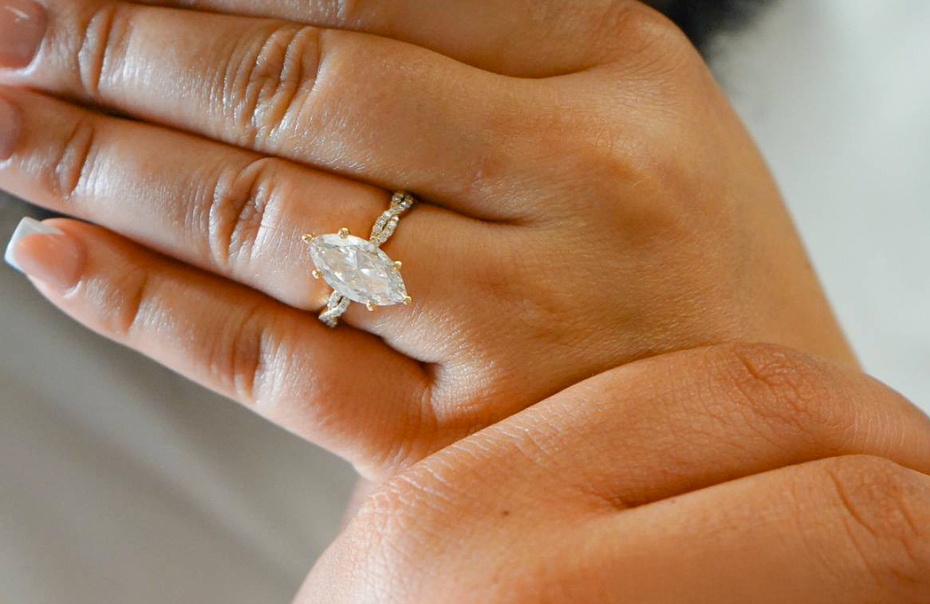
Let’s kill the confusion right now: a lab-grown diamond IS a diamond. Not a look-alike. Not a substitute. Not “basically a diamond.” It’s the same carbon, the same crystal structure, the same fire and brilliance as a stone pulled out of the ground. Put it on a diamond tester and it passes — every time — because it’s a real diamond.
So what’s actually different? One thing: money. What you pay when you buy it, and what it’s worth if you ever sell it. That’s the whole conversation. Everything else is marketing. Here’s the real breakdown, the way we explain it at the counter.
The Science: Identical Down to the Atom
A natural diamond formed around 100 miles under the Earth’s surface over billions of years. A lab-grown diamond forms in a machine using HPHT or CVD technology over a few weeks. Different birthplace, same result.
Chemically, physically, and optically identical. Even GIA, the top gemological lab in the world, needs specialized equipment to tell them apart. Your eye can’t do it. Most jewelers can’t do it without lab tools. And here’s the part our customers care about most:
Lab-grown diamonds pass the diamond tester. Every standard tester on the market reads a lab-grown stone as a diamond, because that’s exactly what it is. Nobody is pulling out a tester at the function and exposing your ring. There’s nothing to expose
The Real Difference: Buy Price and Resale Price
This is where the two stones split, and it’s the only place they split.
Buying
A lab-grown diamond costs 60–80% less than a natural diamond with the same cut, color, and clarity. Same specs, fraction of the price. That means for the same budget, you’re walking out with a bigger stone, a cleaner stone, or both. More shine for less money, period.
Selling
Here’s the honest part most jewelers won’t say out loud: lab-grown diamonds have little to no resale value. Because labs can produce them at scale, the market doesn’t pay for them secondhand the way it pays for natural stones. If you bring a lab-grown diamond back to sell, don’t expect to recover much, in some cases, close to nothing.
Natural diamonds are finite. The Earth isn’t making more on your schedule. That scarcity is why natural stones have historically held value and why they can be sold, traded, or passed down as real assets.
We buy and sell gold and jewelry every day at Pereira Jewelry, so we’re not guessing about this, we see the resale market firsthand. This is the truth we’d tell family.
So Which One Do You Buy? Depends on One Question.
Are you buying this to wear it, or as something you might sell one day?
If you’re buying it to WEAR it: lab-grown wins.
Here’s the example we see in the store every single week. Someone comes in for an engagement ring or a wedding ring. What do they want? A ring that looks beautiful, big, brilliant, and unique. They want her to say yes and everyone at the party to stare at her hand.
What are they NOT thinking about? How much they can resell the ring for later. Because let’s be real, if you’re getting married, you’re not planning for the divorce. Nobody proposes with an exit strategy.
For that buyer, lab-grown is the smartest move in jewelry today:
- Bigger stone for the same budget. The 1-carat budget becomes a 2-carat ring.
- Any shape, any size, made to order. Because lab diamonds are grown, we can get the exact cut, shape, and size the customer dreams of, including custom looks that would be extremely expensive or nearly impossible to find in a natural stone.
- Higher clarity on average. Controlled growth means fewer inclusions, cleaner, whiter, brighter stones.
- It passes the tester. Real diamond, real certificate, real shine.
If you’re buying it as VALUE: natural wins.
If the plan is a stone you might one day sell, trade, or pass down as an asset, natural is the only play. It costs more upfront, but it’s the one that holds a resale market. Rarity is what you’re paying for, and rarity is what pays you back.
The Ethics Question (Quick and Honest)
The natural diamond industry has cleaned up massively since the early 2000s, reputable sourcing today is regulated, traceable, and conflict-free by law. Ask for certification; any legit jeweler will show it.
Lab-grown skips the mining conversation entirely, but growing diamonds takes serious energy, so “lab” doesn’t automatically mean “green.” Both can be sourced responsibly. Buy from a jeweler who’s transparent, that’s the whole answer.
Final Thoughts
Same diamond. Same sparkle. Same pass on the tester. Different price, going in and coming out.
Buying to wear it, love it, and show it off? Lab-grown gets you more diamond for your money, in any shape and size you can imagine. Buying something meant to hold value over time? Go natural and pay for the rarity.
Either way, you deserve the straight answer before you spend a dollar, and now you have it.
Ready to compare them side by side? Come see natural and lab-grown diamonds under the same light at Pereira Jewelry, or explore the collection online. Financing available, get the ring she deserves today.